


If there’s one thing you can’t argue with, it’s Google’s ranking engine.
If it decided my competitors’ content belongs at the top, who am I to argue? 🤔
It clearly likes that content a lot. And my competitors are probably doing something right, producing content Google likes and wants ranked high.
So why go head to head with them instead of following the same path?
Why keep trying to write “super special, complex prompts” for articles when you can use content that already works: it’s indexed, ranks high and gets love from the big G?
I decided to build a complete system: I take my competitors’ content for any keyword, send it to ChatGPT for in-depth analysis, and use it to produce new, better content along the same lines. With this method I get new articles onto page one easily, and sometimes even outrank the competitors themselves 🙂
So here it is: in this video I walk through the whole process from A to Z.
The prompts I work with
These are the prompts I use to analyze the content and turn it into more polished, original content along the same lines.
This first prompt exists purely to brief our Mr. Chat on the whole project and how we’re going to work within it. It’s the first prompt you need to send.
Prompt #1:
Act as an SEO content writer that writes unique, unconventional and helpful content.
Your job is to analyze and investigate content weaknesses among competitors and use them to create better content in terms of quality and SEO.
I’m going to share with you 3 parts of different articles – fetched from the top 3 Google SERPs.
These are the top 3 results for the keyword: “KEYWORD” that I’m trying to rank #1.
In this current prompt, I’m going to share instructions only.
Afterwards, I will share with you the first article fetched from the SERPs then the next one after him until I finish.
It’s going to be 3 articles in total that we are going to investigate.
Each prompt will include a part of an article, it could be the intro, or the middle, or the conclusion of the article.
After each article piece I’m sharing here, respond only with “Article analyzed successfully”.
When I finish with sharing all 3 parts of the articles, I’m going to request you to craft a unique, better article that should outrank all those 3 articles I shared with you on Google Search.
It needs to outrank them In terms of length, content structure. content freshness, uniqueness, SEO practices, quality, storytelling, additions of new aspects and angles around the content. In short – The article you will craft will have to outrank the competitor’s articles.
An article you craft should meet a range of 1,500 to 2,500 words in total. No more, no less.
What is the purpose of this session?
The purpose is to understand the key factors in my competitors’ content that Google chose to rank in the top 3 results, to use and leverage them in my content.
So this means I expect you to give a short summarization of what you think are the strength points of each article before continuing with crafting my article.
After analyzing the article parts, respond with the key factors that we should use in our content, based on your analysis.
Afterwards, you will continue with building the article.
Let’s start, I am sharing the first article in my next prompt.
Only respond with “Let’s start” right now and then I’m going to send it.
The next prompt is a follow-up. Its only job is to understand and show us which points and elements Google liked in this competitor content, and why it decided to rank it high.
We want to know what the strengths are and how we expect GPT to produce the content accordingly.
Prompt #2:
Continue with writing the key factors that led to the success of these articles.
The third prompt instructs GPT to write the article for us, based on the competitors’ content and the instructions we sent it. This is the “real work” prompt.
Prompt #3:
Continue with crafting the outranking article.
The fourth prompt expands the content and increases the word count, because it usually struggles to get past 1,000 words in an article.
Prompt #4:
The article contains only X words.
Add a natural addition of Y words in subsections that I could use in my content.
And this last prompt, after all our back-and-forth with it in the chat, gets us the full article with all our corrections and requests applied based on the instructions.
Prompt #5:
Respond with the full latest version of the article – The complete comprehensive guide.
How has this system worked for me so far?
In a lot of cases I manage to outrank my competitors. Of course, in organic SEO everything depends on many factors: the site needs enough authority, and its technical health and on-page optimization need to be in good shape. But in an apples-to-apples comparison, this is a pretty good way to crack the creation of original, high-quality content that meets Google’s criteria.
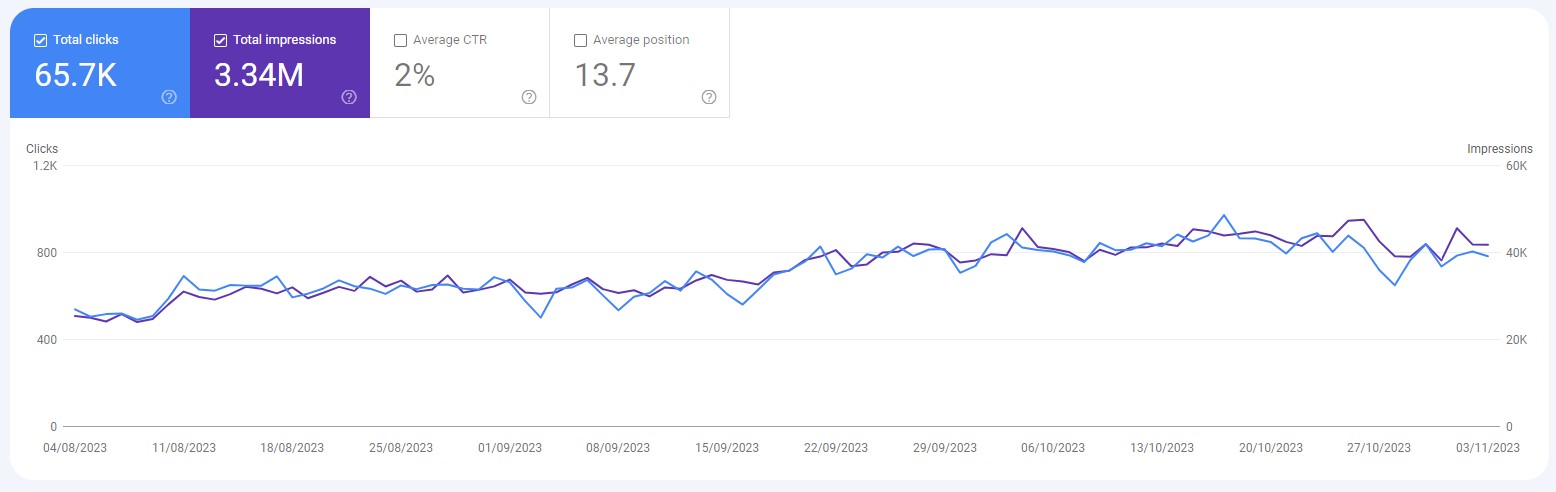
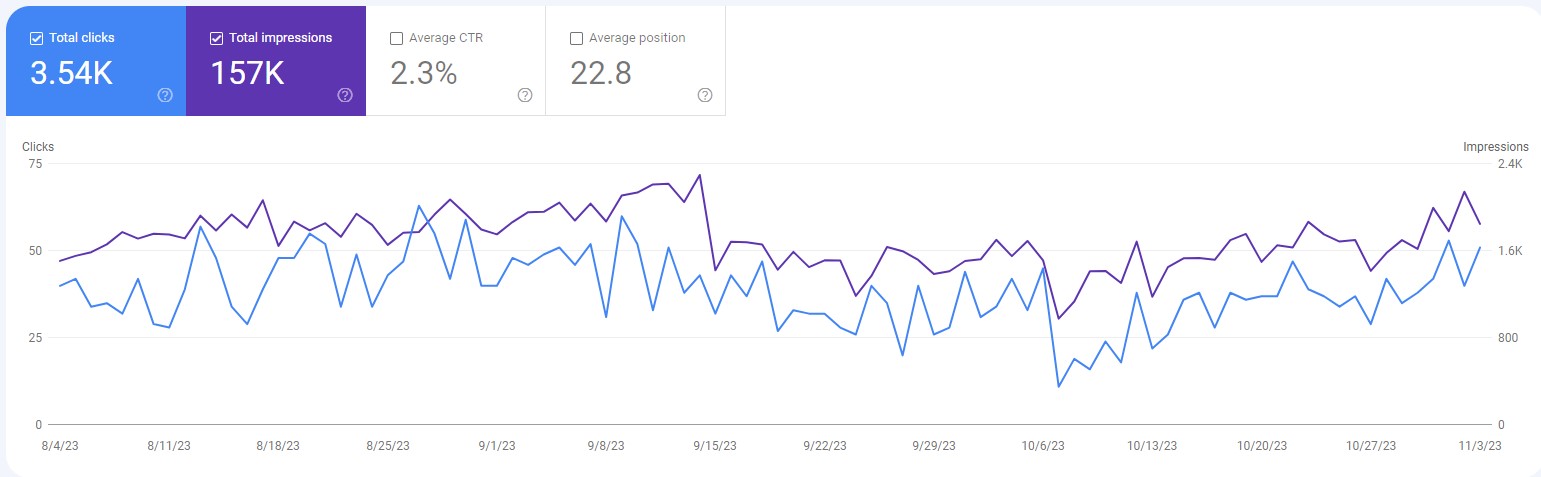
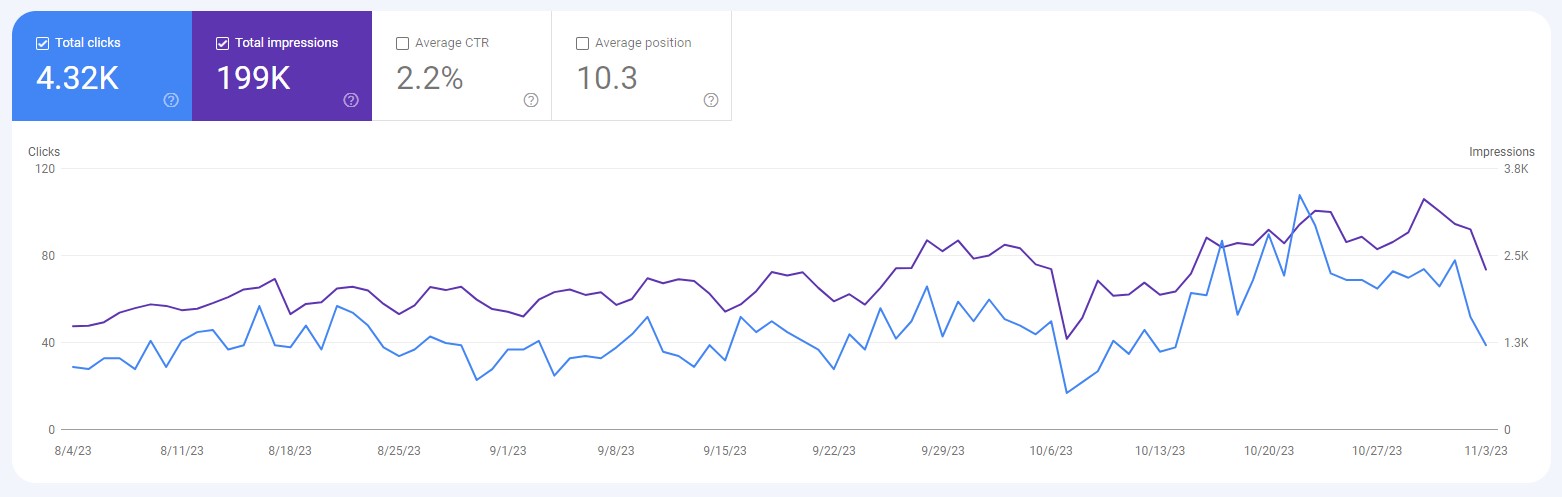
Here are a few traffic examples from our own sites, where my team builds content using exactly this method.
Obviously I can’t reveal the domains, but for illustration, this is the picture over the past 3 months, using this method to create blog content.
Site #1:
Site #2:
Site #3:
Bottom line + more freebies
This method isn’t reinventing the wheel. I’m not the first to work this way.
In the end, content writers and content people in general rewrite material from all kinds of sources: search engines, social networks and more.
Some do it a bit more subtly, some less so.
When it comes to SEO, the goal is always to use a content structure Google likes and add a personal, original touch to our content.
And before I forget,
I highly recommend adding a layer of AI content editing on top of all this, using our great checklist.
If you want the full checklist, join our WhatsApp group. You’ll find it there in the description below.
Meanwhile, we keep finding original ways to create content and do SEO, the kind that brings traffic that turns into deals.
As for you, keep following us in the Facebook community SEO on Autopilot, where we launch every new guide or tool we build.


